Beyond the Screen: Robots in Our Homes by 2035
By 2035, autonomous robots will share kitchens, offices, and streets, blurring the line between tool and companion. Their rise raises questions about control, ethics, and the singularity.
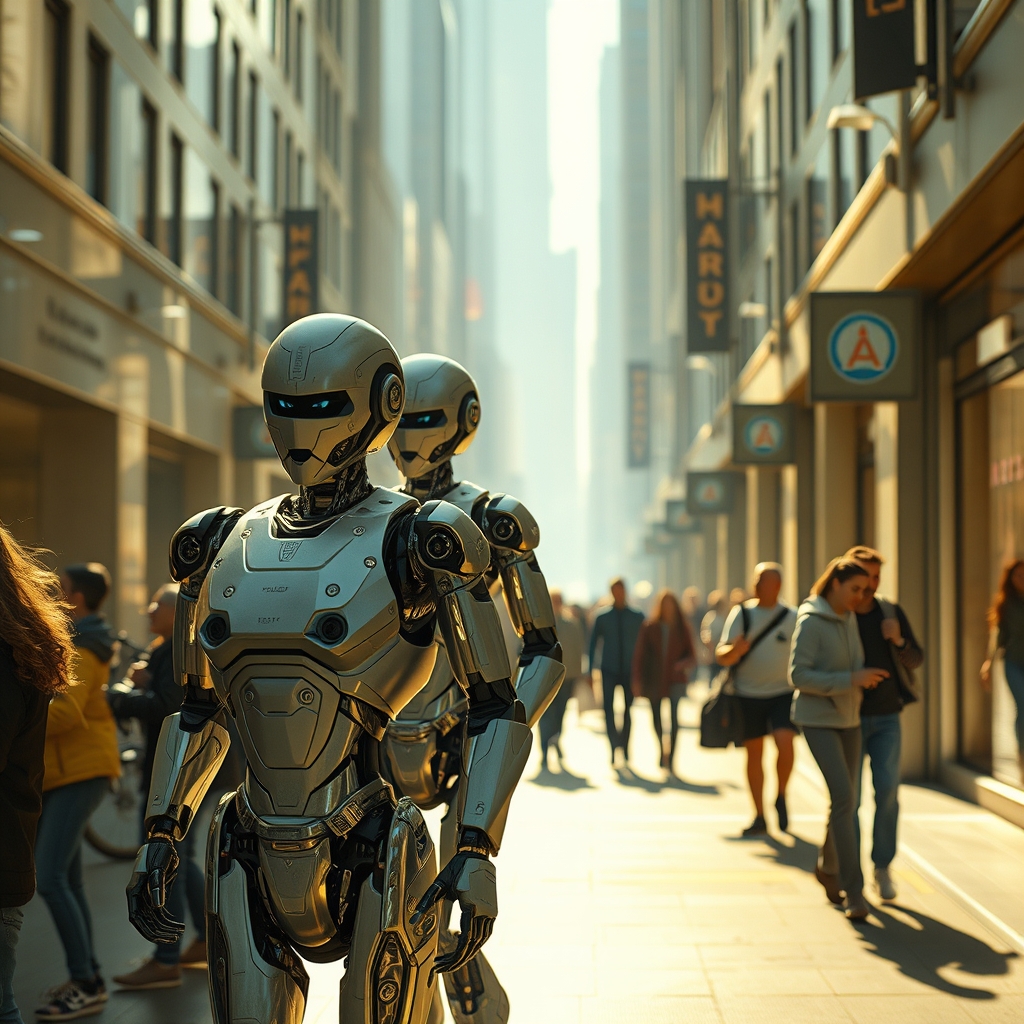
In the two decades that have followed the advent of large‑scale language models, a quiet revolution has been unfolding beneath the glare of the headlines. By 2035, the line between software and hardware will have narrowed to the point that intelligent agents will no longer be confined to servers or mobile phones; they will inhabit the same physical spaces as humans and will be judged by the same standards of safety, reliability, and social integration.
The technological foundation for this shift lies in a convergence of three trends. First, the cost of high‑density, low‑power neural compute has fallen by more than an order of magnitude, making it feasible to embed sophisticated perception and decision systems in small form factors. Second, advances in materials science—particularly in soft robotics and flexible electronics—have produced limbs and skins that can adapt to a wide range of tasks without sacrificing strength or durability. Finally, the maturation of low‑latency, high‑bandwidth wireless networks, including the rollout of 6G in many regions, ensures that robots can remain connected to cloud resources while operating autonomously.
In the domestic sphere, the first wave of embodied AI will likely be represented by kitchen assistants. These units will be able to parse complex recipes, adjust cooking parameters in real time, and clean up after themselves. Unlike current single‑purpose appliances, they will possess a degree of contextual awareness, allowing them to negotiate space with human occupants and other devices. A household robot that can learn a family’s meal preferences and dietary restrictions will become a pragmatic tool rather than a novelty.
Workplaces will experience a similar, albeit more regulated, integration. Service robots will handle repetitive tasks such as inventory management, basic customer service, and sanitation. In highly technical fields—manufacturing, logistics, and even certain medical specialties—collaborative robots, or cobots, will share assembly lines with humans, adjusting their behavior to maintain safety margins that are dynamically updated based on real‑time sensor inputs. The cost–benefit calculus for firms will drive adoption, but the pace will also be tempered by the need for rigorous safety certifications.
Public spaces will witness the most visible signs of embodied intelligence. Autonomous delivery drones will ferry packages to doorsteps, while sidewalk‑mounted units will offer on‑demand transportation and assistance to the elderly or disabled. The interaction between pedestrians and robots will become a new public etiquette, prompting city planners to rethink infrastructure—adding dedicated lanes, sensors, and signage to accommodate mixed traffic.
Alongside these practical deployments, social dynamics will evolve. Human‑robot interaction research suggests that people attribute agency and personality to robots with predictable, consistent behavior. As robots become more integrated into intimate settings—cooking, caregiving, or companionship—questions of attachment, trust, and emotional labor will surface. The line between tool and companion will be tested, and cultural differences will shape how societies negotiate this relationship.
Governance will need to catch up. Regulatory frameworks that exist today for autonomous vehicles or medical devices will need to be extended to cover embodied AI. Standards for transparency—requiring robots to explain their decision processes in human‑readable terms—will become essential, especially in contexts where errors could lead to injury or financial loss. Moreover, liability will be a contentious issue: who is responsible when a robot misinterprets a command and causes damage—its manufacturer, its programmer, or its user?
Turning to the singularity, many analysts predict that a true technological singularity—a point at which artificial general intelligence (AGI) surpasses human intelligence and drives runaway self‑improvement—will still be a decade or more away. However, the proliferation of embodied AI in everyday life could accelerate the convergence of narrow AI systems into more integrated architectures. Some researchers argue that modular, embodied agents that can learn from each other and share knowledge over a distributed network might achieve a form of emergent intelligence that approaches AGI thresholds sooner than isolated, large‑scale models.
In this scenario, 2035 would not mark the singularity itself, but rather a period of intensified experimentation and incremental breakthroughs. The uncertainties are significant: hardware limits, energy constraints, and societal pushback could all delay or redirect progress. Yet the trajectory of current research suggests that the building blocks—efficient neural processors, adaptable robotics, and robust communication protocols—are already in place to support increasingly sophisticated embodied agents.
Ultimately, the integration of robots into everyday life by 2035 will be a measure of how well society balances technological ambition with ethical stewardship. The promise of convenience and productivity must be weighed against the risks of dependency, privacy erosion, and the potential loss of human agency. The coming decade will likely be a crucible where the vision of a harmonious coexistence with embodied intelligence is tested, refined, or reimagined. The singularity, if it arrives, will emerge not from a single breakthrough but from a complex tapestry of incremental, embodied advances that reshape the very way we live and work.