When Robots Become Neighbors: The 2035 Road to Embodied Intelligence
By 2035, service robots may inhabit homes, offices, and streets, but whether their growth heralds a singularity remains uncertain.
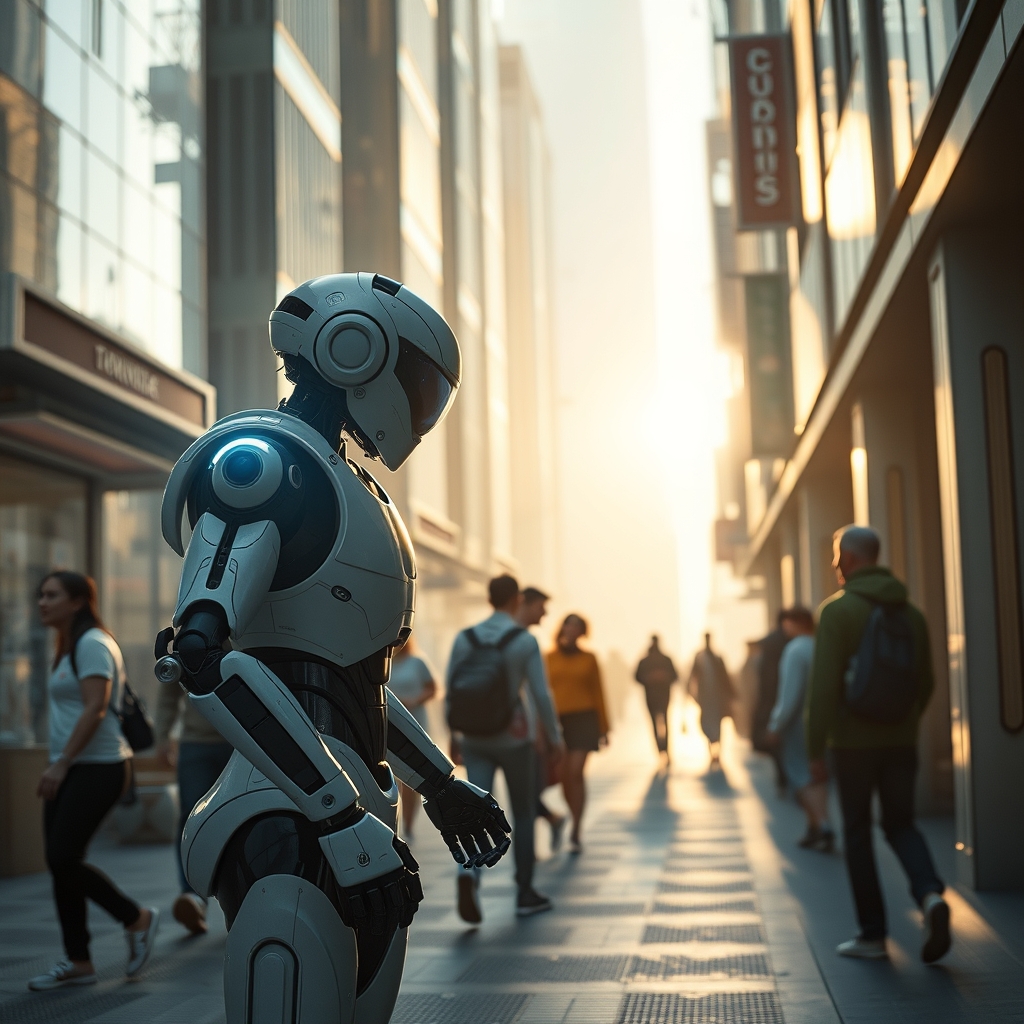
The march toward embodied intelligence has accelerated in recent years, turning what was once the domain of science fiction into a tangible component of everyday infrastructure. By 2035 we expect autonomous mobile units—humanoid assistants, delivery drones, and collaborative industrial bots—to share the same physical spaces as humans, each equipped with advanced perception, navigation, and natural‑language processing modules that allow them to interpret context and adapt behaviour.
These advances are underpinned by three converging technological streams. First, the proliferation of edge computing chips with neuromorphic cores offers the raw processing power necessary for real‑time decision‑making without reliance on distant servers. Second, sensor arrays have become both cheaper and richer, combining lidar, depth cameras, and chemical sensors to provide a multi‑modal view of the environment that closely mirrors human sensory integration. Third, progress in reinforcement learning and meta‑learning has produced algorithms that can acquire new skills from a handful of demonstrations, significantly reducing the time required to deploy a robot in a novel setting.
In domestic settings, we anticipate a modest but significant presence of personal assistants by 2035. These units will go beyond the current generation of vacuum cleaners and smart speakers; they will be capable of carrying out low‑risk household chores, monitoring health vitals, and offering companionship that can recognize and respond to emotional cues. The design of these robots will be informed by extensive user‑experience research, ensuring that form factors are both unobtrusive and socially acceptable. However, adoption will likely be uneven: early adopters will be affluent consumers in urban areas, while rural and low‑income households may experience a slower integration curve.
A parallel wave of regulation will shape the trajectory of embodied AI. Governments are expected to introduce safety certifications that mirror those used in aviation and automotive sectors, requiring rigorous testing for collision avoidance, battery management, and data privacy. International bodies may also collaborate to establish interoperability standards, ensuring that robots from different manufacturers can coexist in shared spaces without conflict. These standards will play a crucial role in preventing the fragmentation of the market that has historically slowed the rollout of complex systems.
Workplace integration is likely to see a more pronounced shift than domestic adoption. Collaborative robots—cobots—will increasingly operate alongside human workers in manufacturing, logistics, and even healthcare. By 2035, many factories will have transitioned to a model where robots handle repetitive or hazardous tasks while humans focus on oversight and creative problem‑solving. This hybrid model may reduce labor costs and increase productivity, but it also raises concerns about job displacement and the need for new skill sets in maintenance, programming, and supervisory roles.
Safety and ethics remain central to public discourse. Even as robots become more capable, the risk of unintended behaviour—such as misidentifying a person or misinterpreting a command—will persist. Researchers are exploring formal verification methods to mathematically prove that certain safety properties hold, but the complexity of real‑world environments limits the completeness of such proofs. Ethical frameworks, too, must evolve to address questions of agency, accountability, and the moral status of highly autonomous systems.
The singularity—a point at which artificial intelligence surpasses human intelligence and triggers exponential technological growth—remains a topic of speculation rather than prediction. Some scholars argue that embodied AI, with its direct interaction with physical reality, could accelerate the convergence of perception and action, narrowing the performance gap between humans and machines. Others caution that the limitations of hardware, energy consumption, and algorithmic uncertainty will keep embodied systems within the realm of narrow AI for the foreseeable future. The 2035 horizon offers a useful benchmark: if we observe a rapid, multi‑layered improvement across perception, cognition, and actuation, the case for an impending singularity gains weight; if instead progress stalls or plateaus, the narrative will shift toward incremental integration.
Uncertainty is inherent in every technological forecast. Market forces, regulatory delays, and societal acceptance will all mediate the pace at which robots enter public life. Moreover, the presence of embodied intelligence does not automatically translate into a singular event; rather, it may simply be a milestone in a longer trajectory of gradual, distributed intelligence. The real measure of success will be how well these systems complement human capabilities, enhance quality of life, and respect the boundaries of safety and privacy.
In conclusion, 2035 will likely witness a visible proliferation of robots that share our physical surroundings and perform useful tasks. Their emergence will be guided by advances in hardware, learning algorithms, and standards, yet the leap to a singularity remains far from inevitable. By treating embodied AI as a tool to augment rather than replace human agency, society can navigate the uncertainties and harness the benefits of a future where robots are not just devices but neighbors in our shared environment.