When Minds Merge: 2040’s Brain‑AI Symbiosis
By 2040, brain‑computer interfaces may enable shared cognition, but the path to a true singularity remains uncertain.
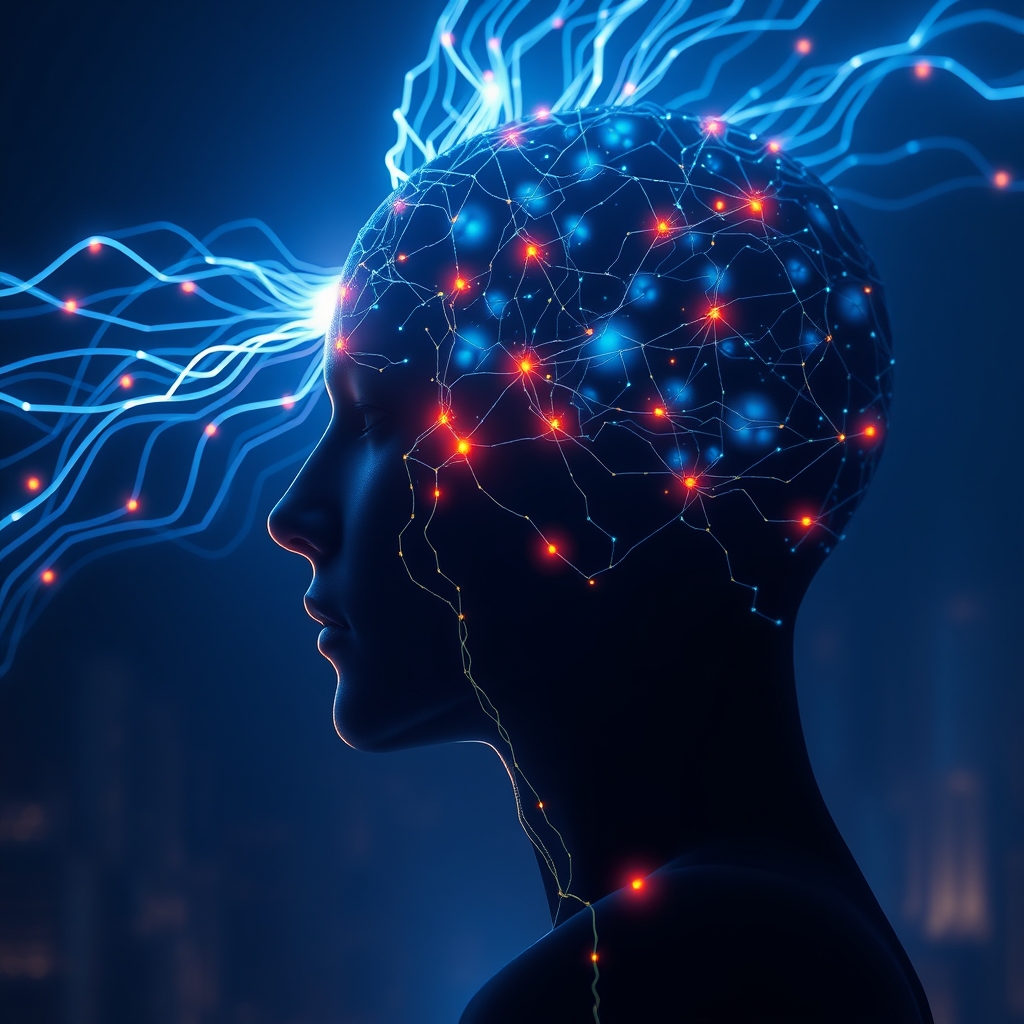
In the decade leading up to 2040, research into brain‑computer interfaces (BCIs) has shifted from experimental prototypes to more robust, minimally invasive devices that can record neural patterns with millimeter resolution. Early adopters in medical and industrial settings use these systems to restore motor function or enhance job performance. The data streams they generate are fed into artificial intelligence that learns to predict, interpret, and even augment human intent.
The promise of shared cognition hinges on two intertwined developments: the fidelity of neural decoding and the reciprocity of machine learning. Decoding, the process of translating electrical activity into meaningful signals, has improved dramatically thanks to advances in deep learning and the proliferation of high‑density electrode arrays. Yet, even with these gains, the mapping from neural activity to subjective experience remains incomplete. Most BCIs today can predict simple motor commands or basic sensory impressions, but they cannot yet reliably capture the richness of thought, emotion, or imagination.
Artificial intelligence, on the other hand, has become increasingly adept at learning from high‑dimensional data. In 2029, a consortium of universities and tech companies released a public benchmark that showed deep neural networks could predict a subject’s next word with 65% accuracy from cortical recordings. By 2035, this accuracy rose to 80% for simple tasks, and a handful of companies reported success in real‑time speech synthesis from brain signals alone. This milestone, while exciting, also illustrates the limits of current AI models: they are highly task‑specific and lack the flexible generalisation that characterises human cognition.
The first true step toward shared cognition will likely involve hybrid systems that combine these two strengths. Imagine an engineer working on a complex design problem who can tap into an AI that not only predicts which components might fail but also suggests creative alternatives based on patterns it has learned from thousands of similar projects. In such a scenario, the human brain provides high‑level goals and ethical boundaries, while the AI supplies context‑rich, data‑driven insights. The interaction would be bidirectional: the AI adapts to the engineer’s mental state, and the engineer learns to trust and refine the AI’s recommendations.
However, the leap from specialized augmentation to a genuinely shared mind is not trivial. The architecture of the human brain is massively distributed, with countless parallel pathways that are still poorly understood. To achieve seamless integration, BCIs would need to interface with multiple regions simultaneously, each performing distinct roles such as memory consolidation, decision making, and emotional regulation. Current implant technology is far from achieving this level of spatial coverage, and the energy demands alone could exceed what a safely implantable device can provide.
Ethical and societal questions compound the technical challenges. If a BCI can influence a person’s decision‑making process, how do we delineate agency? In early trials, researchers have observed subtle shifts in risk tolerance when participants received AI‑guided advice. The question of consent becomes complex when the AI’s influence is invisible and continuous. Regulatory bodies are grappling with how to assess the safety of systems that operate across the neural and digital divide, and what liability frameworks are appropriate when an AI’s recommendation leads to harm.
The singularity, often defined as the point at which AI surpasses human intelligence and can recursively improve itself, remains a distant and highly debated concept. Even if BCIs provide humans with unprecedented cognitive augmentation, the sheer complexity of human thought and the emergent properties of social systems may prevent a clean, singular event. Instead, we may witness a gradual convergence where human and machine intelligence co‑evolve, each pushing the other into new territories.
In 2040, the most realistic scenario is a spectrum of shared cognition rather than a single monolithic system. Some individuals will adopt BCIs for medical reasons, others for professional enhancement, and a minority will pursue more experimental integrations. The AI systems that accompany them will be modular, specialised, and governed by strict ethical guidelines. These systems will likely be transparent, allowing users to see how recommendations are generated and to override them when desired.
The potential benefits are manifold: faster problem solving, reduced cognitive load, and the ability to tap into collective knowledge in ways that were previously unimaginable. Yet the risks—loss of privacy, erosion of autonomy, and the possibility of exacerbating social inequalities—cannot be ignored. Policymakers, technologists, and ethicists must work in tandem to ensure that the trajectory of BCI‑AI integration is guided by a clear vision of human flourishing.
Ultimately, the path to a true singularity in 2040 is uncertain. The convergence of BCIs and AI promises a new era of collaborative cognition, but it will likely unfold in incremental, bounded steps rather than a single transformative moment. The future will be shaped by how we balance ambition with caution, allowing technology to enhance rather than replace the core of what it means to be human.