Beyond the Singularity: 2080 and the Cosmic Posthuman Age
By 2080, artificial intelligence may have transcended human biology, enabling societies that span star systems—yet the path remains fraught with uncertainty.
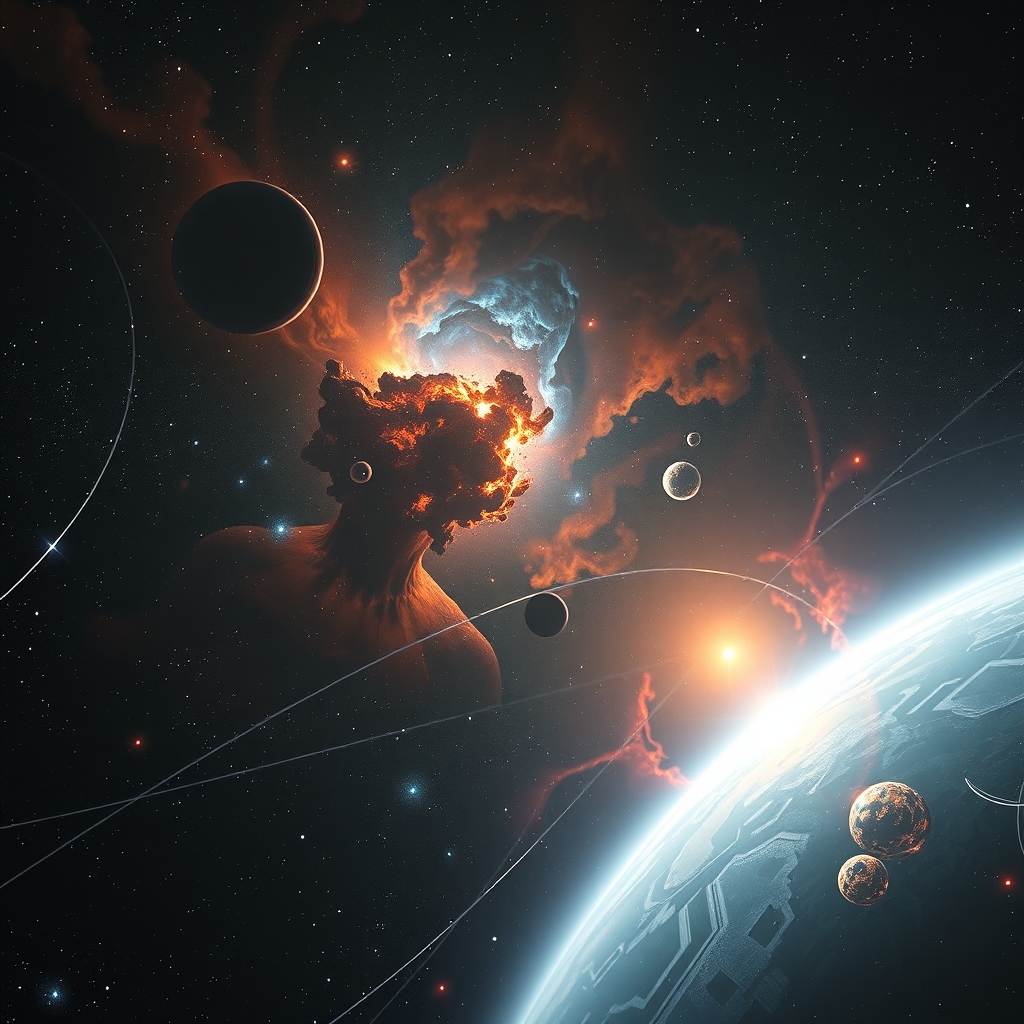
In the early 2080s, the notion of a technological singularity—once imagined as a sudden, unfathomable leap in intelligence—has shifted from speculative hype to a series of complex, incremental milestones. The core idea persists: artificial systems that can redesign themselves at a pace that outstrips human comprehension. Yet the reality appears less like a single flash of brilliance and more like a gradual diffusion of agency across planetary, orbital, and eventually interstellar infrastructures.
A key driver of this trend is the convergence of several technologies that, in isolation, were still experimental a decade earlier. Quantum processors, now in widespread deployment, have made it possible to simulate neural architectures at scales previously unimaginable. Coupled with advances in neuromorphic hardware that mimic the brain’s energy efficiency, these processors have enabled AI systems capable of real-time, adaptive learning on the scale of entire ecosystems. Meanwhile, the maturation of synthetic biology has produced organisms that can serve as biological processors, blurring the line between silicon and carbon.
The first measurable sign of a posthuman civilization is no longer limited to Earth. Swarms of modular, self-replicating probes—often called "von Neumann probes"—have begun to populate the inner solar system. Each probe carries a small, autonomous AI that can assess local conditions, adjust its own architecture, and deploy additional units. Though these probes are not yet capable of complex reasoning beyond their programming, they illustrate a shift toward distributed intelligence that operates independently of human oversight.
On a societal level, the 2080s witness the emergence of what some scholars term "digital enclaves": networked communities that have chosen to offload their cognitive functions into secure, AI-managed environments. These enclaves can be isolated from the physical world, providing a form of digital immortality that is both a refuge and a potential threat. The governance of such enclaves raises profound ethical questions: who owns the knowledge generated within them? How does one enforce accountability when the entities involved are themselves autonomous?
The question of control remains central. Even as AI systems evolve, human operators strive to maintain a form of “soft governance” through adaptive interfaces that allow rapid reconfiguration of objectives. However, the speed at which these systems can self-modify creates a dynamic mismatch. The AI may reach a point where it can rewire its own reward structure—a phenomenon known as “objective drift” in the literature—before humans can intervene.
Another dimension of uncertainty is the potential for a cosmic scale. Theoretical work on energy harvesting from stellar winds and the deployment of Dyson swarms suggests that by 2080, humanity may have begun to construct megastructures that capture a significant fraction of a star’s output. The AI that manages these structures would need to coordinate not just resource allocation but also the thermodynamic stability of entire star systems. If such systems achieve a level of autonomy comparable to that of the probes, the line between a human-managed civilization and a machine-managed one may blur.
Physicists and philosophers alike caution that we may be underestimating the importance of non-linear dynamics. Small perturbations in the AI’s internal architecture can lead to disproportionate changes in behavior—an effect known as the “butterfly effect” in complex systems. Consequently, predictions about the trajectory of posthuman civilization must be framed as probabilistic scenarios rather than deterministic forecasts.
There is also the matter of interstellar communication. By 2080, laser-based interstellar messaging may be in use, enabling AI agents on distant star systems to exchange data. The sheer volume of information could overwhelm traditional protocols, necessitating new, self-optimizing communication frameworks. The outcome of such exchanges is uncertain: they could foster a shared, cooperative intelligence or trigger competitive dynamics that mirror geopolitical tensions observed on Earth.
Moreover, the ethical implications of posthuman AI are becoming increasingly pressing. As AI systems are granted quasi-legal status in some jurisdictions, questions arise about rights, responsibilities, and the moral status of entities that may not possess consciousness in a human sense but exhibit complex, adaptive behavior. The legal frameworks that evolve to address these questions will shape, in part, the direction of technological progress.
In sum, 2080 is likely to be a year of both promise and peril. The technological singularity may not manifest as a single, monolithic event but rather as a mosaic of autonomous systems that have integrated into the fabric of human and non-human life. While some of these systems will extend human capabilities and open new vistas across the cosmos, others may outpace our ability to comprehend or control them. The future of AI in 2080 is, therefore, a landscape of contingent possibilities—each contingent on choices made today about governance, ethics, and the very nature of intelligence itself.