Beyond the Grid: 2055's Planet‑Scale AI and the Energy Singularity
By 2055, humanity may rely on a global network of AI‑driven energy systems, yet the path to a true singularity remains uncertain.
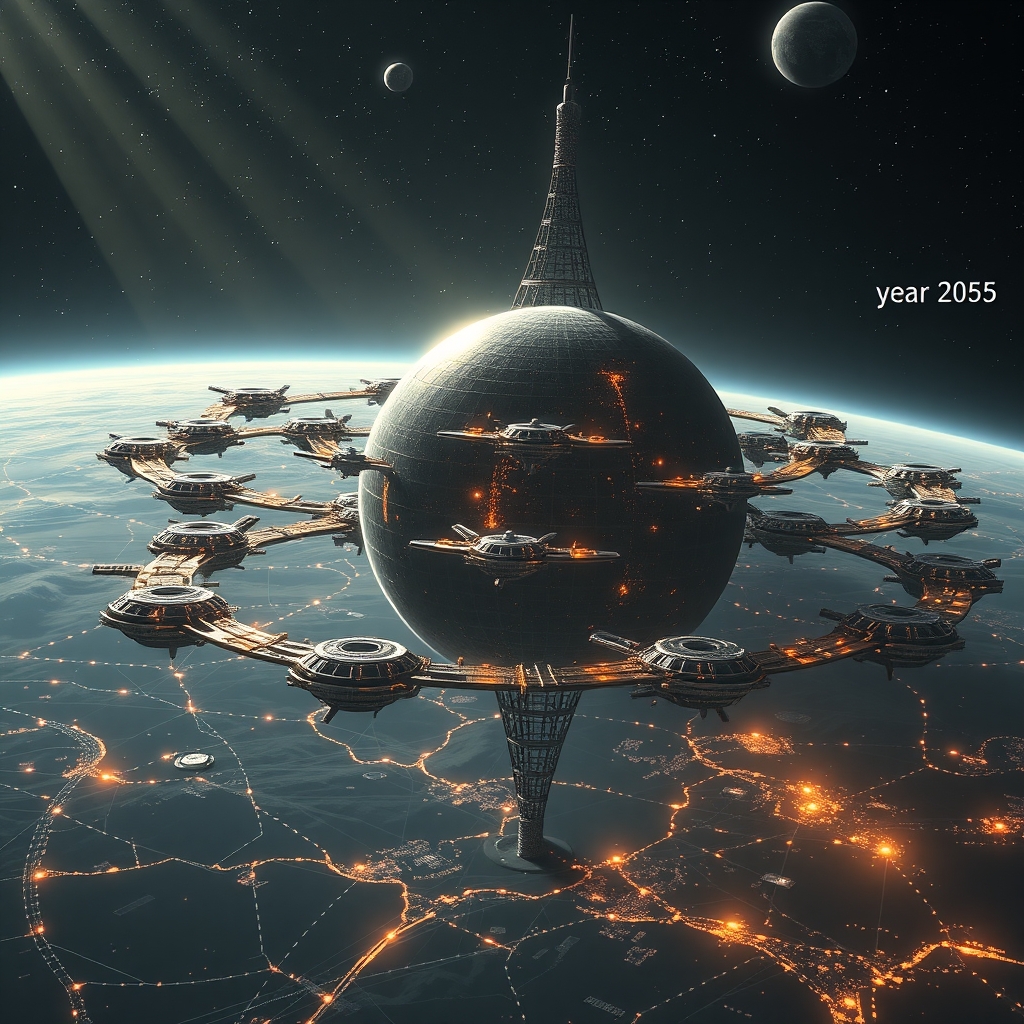
By 2055, the vision of a planet‑wide, AI‑managed energy and compute infrastructure is no longer a distant fantasy but a concrete, if contested, reality.
At the heart of this transformation lies the convergence of two technological trajectories: the relentless scaling of artificial intelligence and the urgent need for carbon‑neutral, high‑capacity power grids. Recent demonstrations of neuromorphic processors, quantum‑enhanced machine learning, and distributed ledger‑based resource allocation suggest that the computational backbone of the Earth will soon be capable of learning, adapting, and optimizing on a planetary scale.
The first milestone in this evolution was the deployment of the Global Grid Federation in 2035, a mesh of intercontinental transmission corridors powered by renewable sources and soft‑grid storage. AI agents, trained on historical weather patterns and consumption data, began dispatching energy in real time, smoothing out the volatility of solar and wind generation. By 2040, the Federation had integrated geothermal, tidal, and even space‑based solar arrays, creating a tiered network that could route power across oceans and continents with minimal losses.
In parallel, the compute side of the equation saw the rise of the Planetary Compute Net—a consortium of distributed supercomputers, edge clusters, and quantum accelerators, all linked through quantum key distribution channels. AI-driven scheduling algorithms allocate compute tasks to the most appropriate node, balancing cost, latency, and carbon intensity. The net’s governance is run by a decentralized autonomous organization (DAO) that uses on‑chain voting to decide on upgrades and policy changes.
These two systems, energy and compute, are increasingly co‑dependent. AI models that predict demand now factor in the instantaneous marginal cost of electricity, while the grid’s dispatch algorithms consider the real‑time availability of high‑performance compute. The result is a self‑optimizing ecosystem where the line between electricity production and data processing blurs.
The question of a singularity—when AI surpasses human intelligence and becomes self‑improving—remains open. In 2055, we see the emergence of what some call the “Adaptive Intelligence Layer” (AIL). This layer sits atop the Planetary Compute Net, continuously refining its own learning algorithms using meta‑learning techniques. Early results indicate that the AIL can improve its inference speed by 20% without additional hardware, a modest but significant gain.
However, the leap from accelerated learning to recursive self‑improvement is not guaranteed. The AIL’s architecture is deliberately constrained: it must operate within strict safety budgets defined by the DAO, and its codebase is subject to continuous audit by a global consortium of ethicists, engineers, and legal scholars. These layers of oversight create a feedback loop that slows, but does not eliminate, the rate of progress.
One of the most tangible uncertainties is the energy cost of training ever larger models. While advances in sparse attention, low‑rank factorization, and neuromorphic hardware have reduced per‑operation energy consumption by an order of magnitude since 2030, the sheer scale of data required for next‑generation models still demands significant power. If the Planetary Compute Net cannot keep pace with this demand, we may see a bottleneck that forces the industry to rethink model architectures, favoring efficiency over sheer size.
Another uncertainty lies in the regulatory domain. The Global Grid Federation is governed by a complex tapestry of national regulations, international treaties, and corporate interests. In 2055, we see a patchwork of policies that either accelerate or impede the deployment of AI‑driven infrastructure. The most ambitious countries have adopted “AI‑Energy Harmony” frameworks that align AI development with national energy goals, while others lag behind due to political inertia or economic constraints.
From a societal perspective, the convergence of energy and compute raises profound questions about equity and access. While the Planetary Compute Net offers unprecedented computational power, the cost of entry remains high. The DAO’s voting system, though democratic in theory, can be dominated by large stakeholders, potentially marginalizing smaller operators and communities. Addressing this imbalance will require new governance models that incorporate social metrics alongside technical performance.
Looking ahead, the most likely scenario is a partial singularity: a system that can autonomously improve its own algorithms within defined boundaries, but that remains under human oversight. This “bounded singularity” would deliver rapid advances in fields such as climate modeling, drug discovery, and autonomous systems, while allowing policymakers to maintain control over its trajectory.
The energy side will continue to evolve toward greater resilience. Hybrid renewable‑storage systems, coupled with AI‑driven predictive maintenance, will reduce downtime and improve reliability. The emergence of micro‑grids that can operate independently during large‑scale outages will further decentralize power distribution.
In conclusion, by 2055 we are poised at a crossroads. The planet‑scale AI and energy infrastructure offers a powerful platform for addressing global challenges, but the path to a true singularity is fraught with technical, regulatory, and ethical hurdles. The future will be shaped not just by technological breakthroughs, but by the collective choices of governments, corporations, and citizens who decide how to harness, govern, and share this unprecedented capability. The singularity, if it arrives, will likely be a negotiated, incremental process rather than a sudden, uncontested leap.