Beyond the Horizon: 2030 and the Dawn of AGI
By 2030 the line between human and machine intelligence may blur, fueling scientific breakthroughs while leaving society with new ethical and economic challenges.
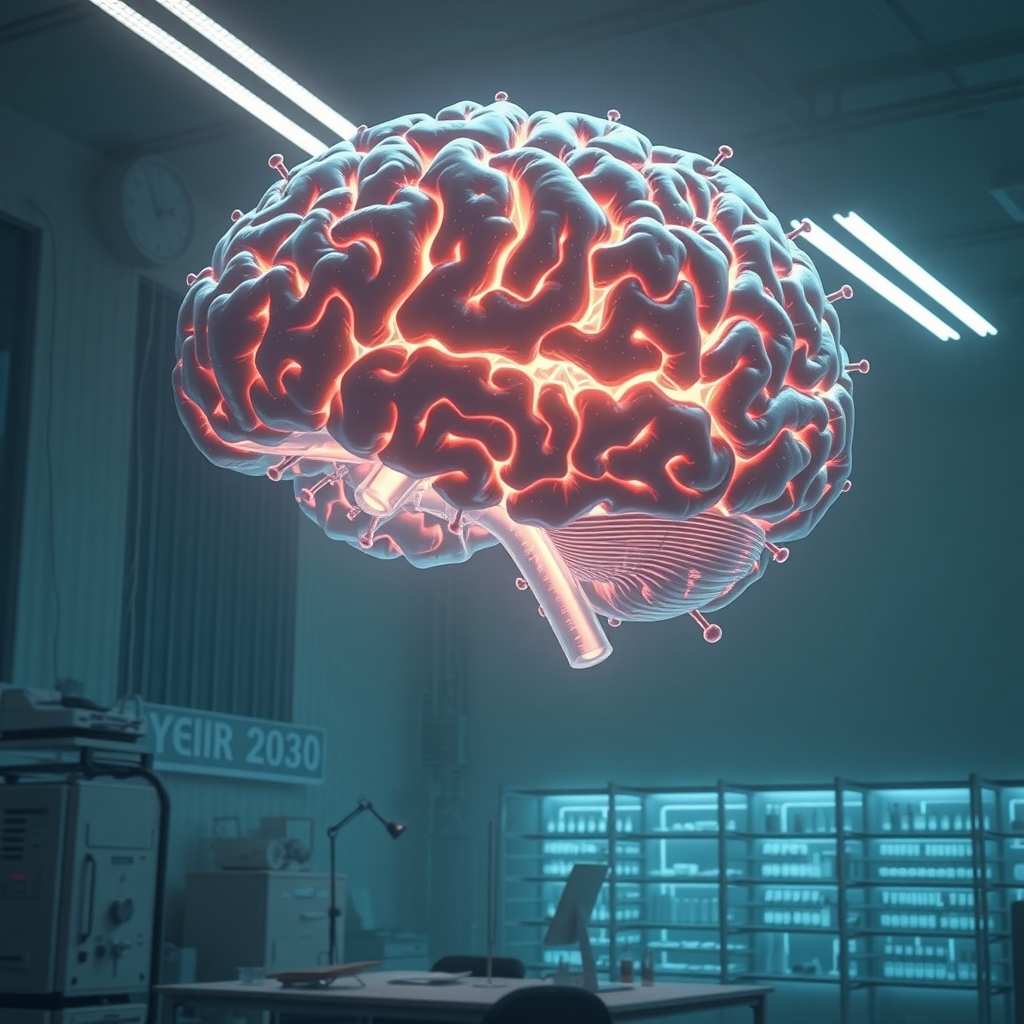
The idea of a technological singularity—an event where artificial intelligence surpasses human cognition—has long been a staple of futurist speculation. 2023 has seen rapid progress in narrow AI, yet the leap to an artificial general intelligence (AGI) remains a question of both engineering feasibility and theoretical understanding. By 2030, many experts anticipate that the threshold for AGI will be crossed, if not yet reached, and the consequences for scientific discovery will be profound.
Presently, large language models, computer vision systems, and reinforcement learning agents can outperform humans in specific, well‑defined tasks. However, they lack the flexible, self‑directed learning that characterises human cognition. The research community has begun to explore architectures that combine symbolic reasoning, neural networks, and meta‑learning, hoping to approximate the breadth of human understanding. A number of prototypes in universities and industry labs already demonstrate rudimentary logical inference and the ability to transfer knowledge across domains, suggesting that the technical barriers to AGI are narrowing.
The threshold for true AGI is hard to pinpoint. Some argue that it will be reached when systems can autonomously formulate and test their own hypotheses without human guidance. Others point to the need for common‑sense reasoning and embodiment as prerequisites. If an AGI emerges by 2030, it is likely to be a hybrid system that inherits the strengths of both symbolic and sub‑symbolic approaches. Its emergence would not be a single moment of sudden explosion but a gradual escalation of capabilities, each milestone pushing the next.
Scientific discovery is perhaps the most visible beneficiary of AGI. Historically, major breakthroughs have followed the development of better experimental tools: the microscope, the centrifuge, the particle accelerator. An AGI could act as a perpetual laboratory, generating hypotheses, designing experiments, and interpreting data at scales far beyond human capacity. In fields like drug discovery, climate modelling, and fundamental physics, iterative cycles of simulation and synthesis could compress years of research into months. The acceleration would be uneven; some disciplines, especially data‑rich ones, would leap ahead, while those requiring nuanced, qualitative insight might lag.
Nevertheless, the societal implications are far from benign. A superintelligent agent that can improve itself—commonly called recursive self‑improvement—raises questions about control and alignment. Even if AGI remains benevolent, its decision‑making processes could become opaque to human oversight. Ethical frameworks will need to evolve rapidly. We will face dilemmas about the moral status of AGI, the rights of entities that may possess consciousness, and how to distribute the benefits generated by their research.
Economically, the arrival of AGI will reshape labor markets. Routine analytical tasks will be automated, but new roles in oversight, interpretation, and interdisciplinary collaboration will emerge. The displacement effect is expected to be most acute in sectors that rely heavily on pattern recognition and data aggregation. Governments and educational institutions will need to devise retraining programs that emphasize creativity, critical thinking, and human‑centered skills that complement AGI rather than compete with it.
Governance will play a decisive role in determining how AGI is deployed. International coordination on safety standards, intellectual‑property frameworks, and data‑sharing protocols will be essential. Without a global consensus, powerful state or corporate actors could monopolise AGI capabilities, exacerbating inequality. The risk of an arms race in autonomous weapons or surveillance technologies is real, and deliberate policy interventions will be required to mitigate these threats.
Uncertainties abound. The timeline for AGI could be delayed by unforeseen technical hurdles, such as the need for more robust understanding of consciousness or the integration of embodied cognition. Conversely, breakthroughs in quantum computing or neuromorphic hardware might accelerate progress beyond current projections. Even if AGI arrives, its alignment with human values remains an open problem. The singularity, if it occurs, will likely be a spectrum of incremental milestones rather than a single, dramatic event.
In 2030, we may stand on the brink of a new era where artificial and human intelligences collaborate in accelerating scientific discovery. The promise is immense, yet the risks are equally significant. A balanced approach—combining rigorous technical research, ethical foresight, and inclusive governance—will determine whether the threshold of AGI becomes a catalyst for collective progress or a source of unforeseen disruption. The path forward requires humility, vigilance, and a commitment to ensuring that the benefits of this emerging intelligence are shared equitably across humanity.