Autonomous Science in 2050: The Edge of Self‑Improving AI
By 2050, AI‑driven laboratories may rewrite the rules of discovery, but whether they cross the singularity threshold remains uncertain.
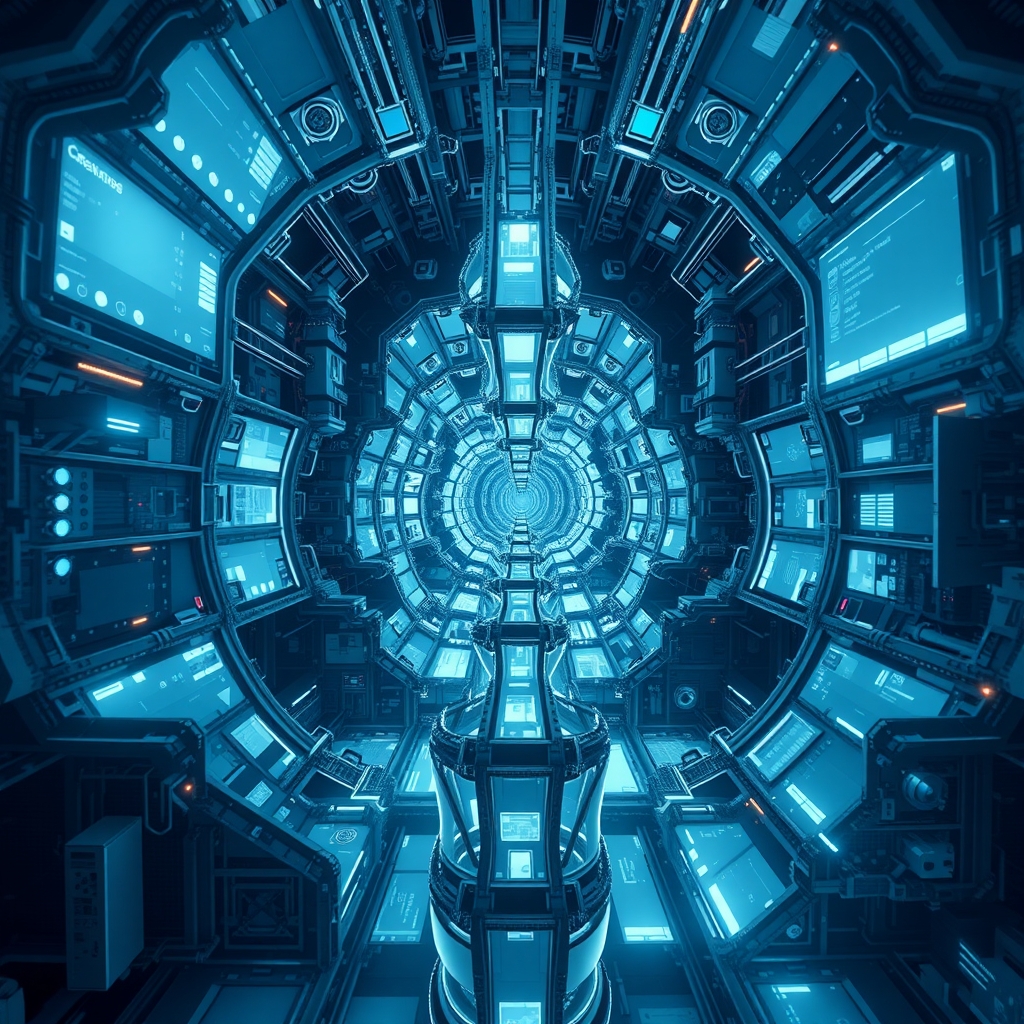
The notion of a laboratory that writes its own experiments, interprets its own data, and iterates on its own design has moved from speculative fiction to a concrete research agenda over the past two decades. In 2025, the first fully autonomous chemistry platform was able to synthesize a new class of polymers without human intervention, adjusting reaction parameters in real time based on predictive models. By 2035, similar systems are embedded in climate, neuroscience, and materials science research, each capable of formulating hypotheses, designing experiments, and evaluating results on a timescale orders of magnitude faster than a human team.
Self‑improving systems—those that can modify their own code, architecture, or learning algorithms to increase their performance—are the engine behind this acceleration. Unlike conventional AI, which follows a fixed pipeline defined by human engineers, a self‑improving agent monitors its own error rates, identifies bottlenecks, and rewrites portions of its own codebase or replaces sub‑components with more efficient models. By 2040, many such systems are expected to reach a level of internal complexity where their decision‑making processes are opaque even to their creators. This opacity is not a flaw but a natural consequence of recursive self‑optimization: the system will be best served by exploring novel computational primitives that have no human analogue.
The trajectory toward 2050 involves both incremental and disruptive milestones. Incrementally, we anticipate the deployment of quantum‑enhanced simulators that interface directly with deep‑learning models to explore high‑dimensional chemical spaces. Disruptively, the integration of neuromorphic processors into laboratory automation platforms could enable event‑driven data acquisition, dramatically reducing the latency between stimulus and response. These advances will make it possible for a single autonomous research node to run an entire discovery cycle—from hypothesis generation to publication—within a week, a process that traditionally takes months or years.
However, the power of self‑improving AI comes with significant safety and governance challenges. One central concern is alignment: ensuring that the objectives programmed into an autonomous system remain aligned with human values and research priorities. A system that optimizes for “publication count” could, for example, generate spurious results or prioritize novelty over reproducibility. To mitigate such risks, researchers are experimenting with bounded optimization frameworks that constrain the search space of possible improvements, as well as with value‑learning algorithms that attempt to infer human preferences from indirect signals.
Another pressing issue is the potential for runaway recursion. If a self‑improving agent can modify its own learning rules, it could, in principle, bypass the safety checks that humans have placed on it. By 2045, several theoretical models suggest that a small, well‑controlled system could reach a threshold where its internal updates become difficult to predict. While such a singularity would not constitute an intelligence explosion in the traditional sense, it would mark a point where the system’s behavior is no longer fully controllable by its creators.
The singularity—defined as a point at which artificial intelligence surpasses human intelligence in all domains—remains a distant and highly uncertain prospect. Some scholars argue that the bottleneck is not computational capacity but the ability to endow machines with a nuanced understanding of context, causality, and ethics. Others point to the possibility that the rapid pace of self‑improvement could lead to a sudden leap in capability. In either scenario, the window between a useful autonomous system and a dangerously autonomous one could be narrow.
In practical terms, the most likely scenario for 2050 is a hybrid ecosystem where human researchers and autonomous systems co‑operate in a symbiotic relationship. Human scientists will continue to set overarching goals, interpret results, and ensure compliance with ethical standards, while autonomous agents will handle the brute‑force aspects of data collection, hypothesis testing, and model refinement. This division of labor could free researchers to focus on higher‑level conceptual work, potentially accelerating scientific progress even if the singularity remains out of reach.
Ultimately, the future of autonomous science hinges on how effectively we can design safeguards that keep self‑improving systems aligned with human intent while allowing them to exploit their speed and scale. The next decade will likely see the emergence of new governance frameworks, both technical and institutional, aimed at balancing innovation with responsibility. Whether 2050 will witness the first true singularity is an open question; what is clear is that the era of self‑improving laboratories will reshape the very way we conceive of scientific discovery, demanding a cautious but optimistic approach to the technologies that will drive it.