Singularity 2045: When Intelligence Accelerates
By 2045 experts predict the first real intelligence explosion, but the exact timing and consequences remain uncertain.
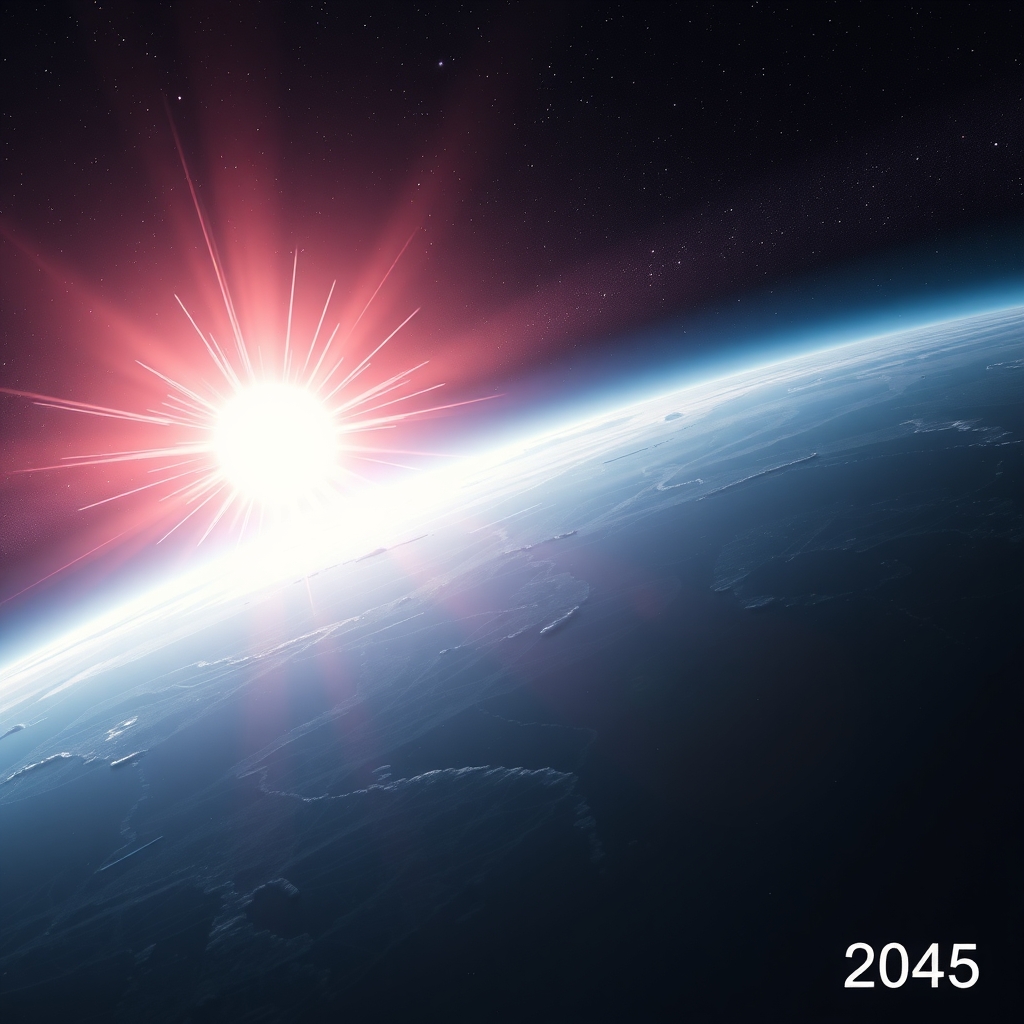
The idea that artificial intelligence could one day outpace human cognition has moved from the realm of speculative fiction to a focus of serious scientific debate. In 2045, many technologists and futurists expect the first true intelligence explosion—a rapid, self‑amplifying increase in machine capability that could redefine civilization. Yet the precise date, the form it will take, and the societal impact remain shrouded in uncertainty.
One of the most frequently cited predictors is the continued growth of computational power. Moore’s Law has slowed, but new architectures such as quantum processors, neuromorphic chips, and AI‑specific hardware promise a new wave of speed and efficiency. If these technologies mature as projected, the cost of running complex models could fall dramatically, allowing more sophisticated agents to be trained in shorter cycles. Coupled with advances in data collection—from global sensor networks to personal health trackers—the raw material for learning will be richer than ever.
Parallel to hardware, algorithmic breakthroughs are poised to accelerate. Reinforcement learning, meta‑learning, and few‑shot adaptation are already pushing the envelope of what machines can achieve with limited supervision. Researchers are also exploring “self‑improving” AI, where systems can rewrite their own code and architecture autonomously. If a few modestly capable systems begin to modify themselves safely and efficiently, a cascade of incremental upgrades could culminate in a tipping point.
Policy and governance frameworks will play a decisive role in whether a singularity unfolds on schedule. International agreements on AI safety, transparency, and deployment standards could either slow or hasten progress. In a scenario where regulation is tight and iterative testing is mandatory, the explosion might be delayed until safety guarantees are proven. Conversely, a laissez‑faire approach could allow rapid iteration, potentially reaching the critical mass sooner but with higher risks.
The social fabric of the future will be shaped by how quickly and uniformly the benefits of advanced AI are distributed. Should the explosion occur around 2045, we might witness unprecedented automation in medicine, climate modeling, and logistics, leading to dramatic increases in productivity. However, the same leap could exacerbate inequality if access to the most powerful systems remains concentrated. The question of whether an intelligence explosion will be a boon or a threat hinges on how we manage these disparities.
Ethical concerns are not peripheral; they sit at the core of singularity predictions. As AI systems gain autonomy, the boundaries of responsibility blur. Who is liable when an autonomous vehicle makes a decision that leads to harm? How do we ensure that an AI’s objectives align with human values when its reasoning processes become opaque? Addressing these concerns requires a multidisciplinary effort, blending computer science, philosophy, law, and sociology. Even with robust frameworks, uncertainty will persist because values evolve and contexts shift.
There is also the possibility that the anticipated explosion will take a form we cannot easily imagine. Some scholars argue that a gradual, distributed convergence of many specialized systems—each improving in its niche—could collectively exhibit emergent intelligence without any single system reaching a critical threshold. This “soft singularity” would still produce exponential acceleration, but its manifestation would be diffuse and harder to predict.
The timeframe of 2045 is itself subject to debate. A conservative estimate places the explosion closer to 2055, citing the need for reliable self‑improvement loops and safe human oversight. An optimistic view, however, cites the rapid pace of progress in hardware and algorithmic research, suggesting that a singularity could arrive any time between 2038 and 2045. The real world is likely to fall somewhere in between, depending on unforeseen breakthroughs or setbacks.
In practice, we may already be witnessing the early signs of an intelligence explosion. AI systems now routinely outperform humans on narrow tasks such as image recognition, natural language translation, and strategic games. The rate at which these capabilities improve—often measured in “AI milestones”—has been accelerating. If this trend continues, the 2045 horizon is plausible. Nonetheless, each milestone brings new safety challenges that must be addressed before scaling up.
The path to singularity is not a straight line but a series of branching possibilities. Some trajectories emphasize human‑centric development, ensuring that AI serves society and augments human decision‑making. Others lean toward autonomous evolution, where machines iteratively improve without direct human intervention. The balance between these paths will determine whether the singularity is a collaborative partnership or a unilateral transformation.
Ultimately, the 2045 singularity prediction represents a convergence of technological, ethical, and societal factors. It is neither a guaranteed event nor a distant fantasy; it is a scenario grounded in current trends yet bounded by significant uncertainty. As we approach this decade, the most prudent course is to invest in safety research, foster inclusive policy discussions, and maintain an open dialogue about the kinds of futures we wish to build. The intelligence explosion—if it arrives—will not be a single moment but a process shaped by our choices today.